 An official website of the United States government.



OSC & EUSST Study Opportunities for International SSA Information Sharing
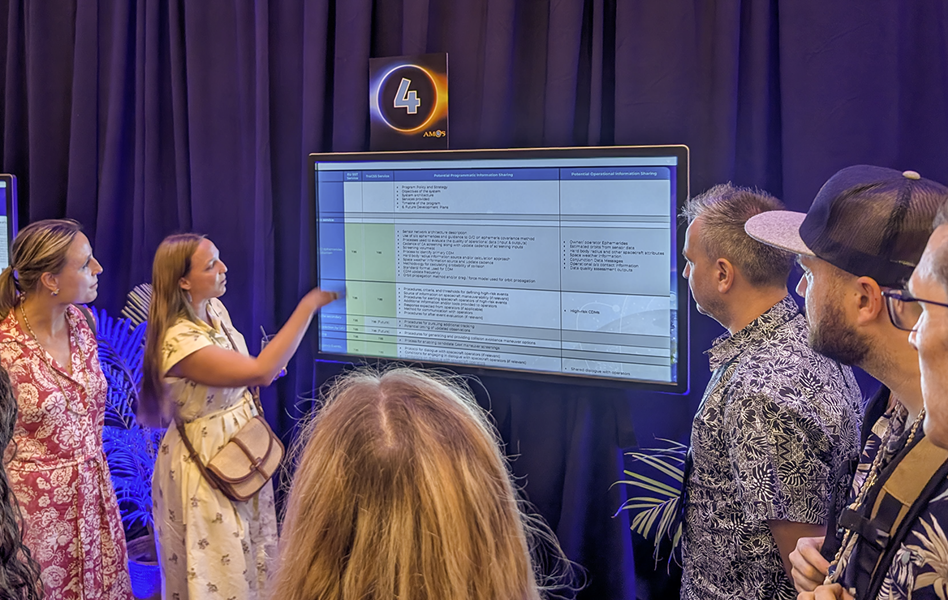
OSC’s Head of International SSA Engagement, Mariel Borowitz, presents findings from the joint study at the 2025 AMOS Conference.
Opportunities for SSA Information Sharing
There are multiple independent national and regional space situational awareness systems around the world. These systems use sensors to track objects in space, estimate their present and expected future location, and identify any close approaches between two objects that could potentially result in a collision.
Advanced warning of these potential collisions allows spacecraft operators to determine whether it is necessary to carry out a maneuver to avoid a potential collision and coordinate with counterpart operators, if necessary. These services are essential to global spaceflight safety and sustainability.
However, each of these systems uses different data sources and different algorithms and processes, and thus, they can be expected to produce at least somewhat different solutions.
To minimize the extent to which spacecraft operators receive conflicting information, it is important to facilitate coordination and information sharing among these systems. However, there are many questions about what international coordination could or should entail. What types of information should be shared, and why? What are the highest priorities for information sharing and coordination? What procedures might be needed to enable coordination?
OSC – EU SST Joint Study
At the 2025 AMOS Conference, the Office of Space Commerce’s Traffic Coordination System for Space (TraCSS) program and European Union Space Surveillance and Tracking (EU SST) program published a joint study (copyright © 2025 Advanced Maui Optical and Space Surveillance Technologies Conference (AMOS), www.amostech.com) that advances our understanding of these issues through a case study of information sharing cooperation between the two systems (table below). This is the latest in a series of joint studies between the two programs focused on advancing international SSA cooperation, a goal of the Office of Space Commerce’s Vision for Global SSA Coordination.
Opportunities for Programmatic and Operational Information Sharing Among SSA Systems
| EU SST Service | TraCSS Service | Potential Programmatic Information Sharing | Potential Operational Information Sharing | |
|---|---|---|---|---|
| Program Overview | 1) Program Policy and Strategy. 2) Objectives of the system. 3) System architecture. 4) Services provided. 5) Timeline of the program. 6) Future Development Plans. | |||
| Services | ||||
| 1. Routine catalog and O/O ephemerides screening and CDM production. | Yes | Yes | 1) Sensor network architecture description. 2) Use of O/O ephemerides and guidance to O/O on ephemeris covariance method. 3) Processes used to evaluate the quality of operational data (inputs & outputs). 4) Cadence of CA screening along with updates of cadence of screening inputs. 5) Screening volume(s). 6) Process to identify primary CDM. 7) Hard body radius information source and/or calculation approach. 8) Space weather information source and update cadence. 9) Methodology for calculating probability of calculation. 10) Standard format used for CDM. 11) CDM update frequency. 12) Orbit propagation method and/or drag/force model used for orbit propagation. | 1) O/O ephemerides. 2) Estimated orbits from sensor data. 3) Hard body radius and other spacecraft attributes. 4) Space weather information. 5) Conjunction Data Messages. 6) Operational O/O contact information. 7) Data quality assessment outputs. |
| 2. Risk assessment and detection and notification of high-interest events/emergency events. | Yes | Yes | 1) Procedures, criteria, and thresholds for defining high-risk events. 2) Sources of information on spacecraft maneuverability (if relevant). 3) Procedures for alerting spacecraft operators of high-risk events. 4) Additional information and/or tools provided to operators. 5) Response excepted from operators (if applicable). 6) Method for communication with operators. 7) Procedures for after-event evaluation (if relevant). | 1) High-risk CDMs |
| 3. Additional tracking on the secondary and/or primary objects. | Yes | Yes (future) | 1) Procedures for pursuing additional tracking. 2) Potential timing of updated observations. | |
| 4. Basic CAM options for selection by O/O. | Yes | Yes (future) | 1) Procedures for generating and providing collision avoidance options. | |
| 5. Candidate CAM screening. | Yes | Yes | 1) Process for enabling candidate CAM maneuver screenings. | |
| 6. For selected HIE/Emergency events, dialogue with O/O. | Yes | Yes | 1) Protocol for dialogue with spacecraft operations (if relevant) 2) Conditions for engaging in dialogue with spacecraft operators (if relevant). 3) Limitations on dialogue with spacecraft operators. 4) Common questions from spacecraft O/Os. | 1) Shared dialogue with operators. |
| Candidate Maneuver Screening | No | Yes | 1) Process for screening candidate maneuvers (if relevant) | |
| Spacecraft Anomaly Reporting | No | Yes | 1) Process for anomaly reporting (if relevant). 2) Process for sharing anomaly information (if relevant). | 1) Anomaly reports. |
| Reentry Monitoring Service | Yes | Yes (future) | 1) Description of re-entry monitoring service. 2) Process for developing re-entry predictions. | 1). Re-entry predictions. |
| Fragmentation Notification and Analysis Service | Yes | Yes (notification only) | 1) Description of fragmentation and/or analysis service. 2) Process for sharing fragmentation notifications. | 1) Fragmentation notifications. |
Looking Forward
Coordination between EU SST and TraCSS is an important first step, but to support global spaceflight safety, it is important to expand coordination to other SSA providers around the world. The overall goals and processes described here with respect to cooperation between EU SST and TraCSS also apply to other SSA systems. Improved transparency, compatibility, and interoperability among independent systems would help to ensure spacecraft operators receive more consistent guidance on spaceflight safety issues and events. It would also facilitate improved coordination among spacecraft operators.