 An official website of the United States government.


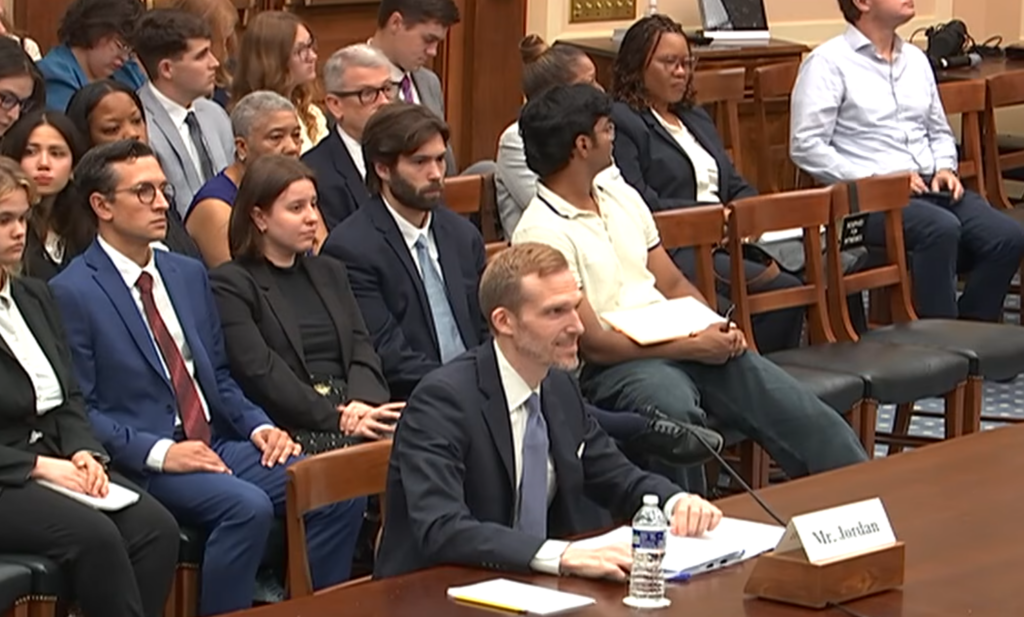
Director Jordan Testifies on OSC’s “Space Commerce Certification”
“U.S. industry is at the cutting-edge of science, technology, and exploration—and leads the world in space capabilities. This is a sector that moves at the pace of innovation, and to remain the leader into the future, it requires a regulatory structure and environment that can match its pace.”
– The Honorable Taylor Jordan, Director, Office of Space Commerce
On Wednesday, July 15, 2026, OSC’s Director, Assistant Secretary Taylor Jordan, testified before the U.S. House of Representatives Science, Space, and Technology Committee’s Space Subcommittee in a hearing entitled “A Review of the Office of Space Commerce’s Mission Authorization Proposal.“
In Executive Order 14335, “Enabling Competition in the Commercial Space Industry,” President Trump directed the Department of Commerce to develop a process to authorize commercial activities in space not clearly or straightforwardly governed by existing regulations – everything from satellite servicing to commercial space stations and manufacturing on the Moon.
On March 24, 2026, OSC released its updated mission authorization proposal – the “Space Commerce Certification” – for public review and comment.
Watch the Recording:
Written Testimony of Director Jordan:
Chairman Haridopolos, Ranking Member Foushee, and members of the Committee, thank you for the opportunity to testify before you today. I am Taylor Jordan, the National Oceanic and Atmospheric Administration’s (NOAA) Assistant Secretary for Environmental Observation and Prediction and Director of the Department of Commerce’s Office of Space Commerce (“OSC”).
The Department of Commerce and OSC support one of America’s greatest strategic advantages: the unparalleled innovation of our commercial space sector. Our U.S. industry is at the cutting-edge of science, technology, and exploration—and leads the world in space capabilities. This is a sector that moves at the pace of innovation, and to remain the leader into the future, it requires a regulatory structure and environment that can match its pace.
I am here to discuss our coordination proposal that meets industry where they are today: the Space Commerce Certification. This proposal delivers a streamlined approach for emerging space markets and technologies that our entrepreneurs need to move fast, attract investment, and cement U.S. space leadership for the next century.
Introduction
The U.S. commercial space sector has evolved from a government-driven frontier into the vital infrastructure that supports our modern economy and way of life. It powers global telecommunications, guides precision agriculture, enhances national security through remote sensing, and forms the bedrock of our numerical weather predictions that are crucial for the protection of American life and property. Although we may not see it, it is integral to almost every aspect of our lives. But it could do even more. Today, American companies are actively laying the groundwork for entirely new economic domains, from in-orbit manufacturing of novel pharmaceuticals that could revolutionize drug discovery and enhance biologic medications, to energy infrastructure through in-space solar, and even towards the future of a cislunar economy.
The commercial space sector has grown immensely in just a few short years. The space sector is on track to become a $1 trillion-plus industry within the next two decades, fueled by rapid growth in commercial satellites, launch services, and space-enabled technologies. American companies are leading the way. They are no longer focused simply on communications and remote sensing, but are joined by innovators conducting missions to the Moon, developing private space stations, servicing satellites, and building orbital data centers. We refer to these efforts as novel in-space activities, and the current licensing regime is not designed to address them:
- The Federal Aviation Administration (“FAA”) regulates launch and re-entry.
- The Federal Communications Commission (“FCC”) regulates radiofrequency transmission.
- The Department of Commerce regulates remote sensing.
Everything else—from foreign policy, international obligations, and national security to complex orbital maneuvers and orbital debris mitigation—is shoe-horned into legacy processes never designed to handle them.
To put it simply, U.S. regulations as they exist today do not offer a clear path to “yes” for novel activities. Instead, they risk trapping our industry in an endless interagency maze.
In Executive Order 14335, President Trump directed the Office of Space Commerce to propose a solution. In close consultation with industry stakeholders and interagency partners, OSC developed a certification process that could provide more clarity for industry, protect core U.S. Government interests, and improve intragovernmental coordination.
The Space Commerce Certification
The cornerstone of the OSC’s proposal is the creation of a Space Commerce Certification that is intended to unify existing regulatory pathways into a clear, straightforward, centralized process. The process would not replace existing DOC, FAA, or FCC statutory responsibilities.
Rather than forcing companies to navigate multiple different agencies (and multiple regulators) independently, if industry chooses, OSC would serve as a regulatory clearinghouse for novel inorbit activities:
- OSC’s certification process would gather information from applicants that does not fall clearly within other space-regulating agencies’ mandates (but which is required under current licensing processes) and incorporate it into a single, voluntary application.
- OSC would circulate this application to the Department of War (“DoW”), FAA, FCC, Department of State (“State”), and National Aeronautics and Space Administration (“NASA”) to review.
- Following DoW, NASA, and State confirmation that these missions do not undermine national security, operational safety, or international obligations or foreign relations of the United States, OSC would provide a Space Commerce Certification to the applicants. The FAA and FCC, at each agency’s discretion, could leverage the Space Commerce Certification to waive relevant sections of their regulations or bypass separate interagency review.
As a result, commercial operators with missions that involve activities that are not clearly or straightforwardly regulated would have a clear path to U.S. government authorization through a single government entity, utilizing a process that is tailored to their needs.
Novel Missions, Novel Approach – Key Principles
Our proposal has been built upon several underlying principles: agility over bureaucracy; regulatory innovation to meet industry innovation; presumption of approval; and efficiency in oversight.
OSC intends to build the process dynamically through an extended pilot and by leveraging emerging industry standards. OSC’s role would be to validate and clear industry-led norms, not to dictate engineering requirements for activities that outpace regulatory scope.
A key pillar of our process is the presumption of approval. For novel space sectors, regulatory ambiguity prevents the free flow of capital. By shifting the burden so that an application for a Space Commerce Certification is presumed approved unless the government can articulate specific, narrowly constrained concerns, this process would give investors the predictability they need that supports the growth of the industry. It would require the government to justify a “no,” rather than forcing the innovator to beg for a “yes.”
This proposal is also intended to ensure minimally burdensome, efficient continued compliance with Article VI of the 1967 Outer Space Treaty, which requires the U.S. to provide “authorization and continuing supervision” for non-governmental space activities. The certification process would ensure continued fulfillment of our international legal obligations without installing burdensome federal regulatory systems. If U.S. Government oversight is transparent and efficient, companies will continue to innovate in America. If it is oppressive, they may choose foreign “flags of convenience,” causing the U.S. to lose both economic leadership and the ability to shape global space safety norms.
Deliberately Designed To Be Transparent
In this modern era of American space enterprise, our private and public space sectors are inexorably linked in partnerships across the economic, civil, scientific, and national security spheres. This reality necessitates that the government work collaboratively with its industry stakeholders, not in opposition to them.
Over the years, industry has asked for greater government transparency in the authorization process. The fact that there is no clear process for authorizing novel space activities is bad for business, bad for innovation, and ultimately, bad for the American taxpayer. Our Certification process would hold OSC and its agency partners to a higher standard: to be clear about the questions they ask, the reasons they ask them, and the decisions they make as a result. OSC’s proposal has been informed and shaped through deliberate transparency from the very start. The Office has engaged and continues to engage in extensive direct consultation with industry and other stakeholders on the best approach to streamline the authorization process:
- On December 3, 2025, OSC held an online event to discuss preliminary concepts for the eventual U.S. regulatory authorization of “novel” commercial space activities.
- On December 17, 2025, OSC posted its initial draft concept on its public website, seeking “the perspectives, inputs, and feedback regarding this draft concept from the public stakeholder community.” Over three dozen individual responses were received.
- On January 9, 2026, OSC hosted a briefing on its concept with the “Consortium for Execution of Rendezvous and Servicing Operations,” a trade group representing companies actively developing “novel” space technologies and concepts.
- On March 24, 2026, OSC published its updated proposal on its public website, describing in detail proposed application contents, certification amendments, the application process, review process, and conditions for ongoing supervision and appeal.
- In May 2026, OSC held an open industry stakeholder feedback session on its updated proposal at the AIAA ASCEND conference.
- In June 2026, OSC held a consultation with the legal and regulatory audience attending the American Bar Association’s Forum on Air & Space Law.
The record of public endorsement and support for the Space Commerce Certification is emblematic of OSC’s work to proactively incorporate stakeholder perspectives, recommendations, and feedback—and address the real-world needs of the market.
Interagency Coordination
In addition to consultation with public stakeholders, OSC continues to work with the White House and agency partners, including the FAA, FCC, NASA, State, and DoW, in order to coordinate E.O. 14335’s express direction to streamline authorization for activities that were not clearly or straightforwardly regulated at the time it was issued.
Conclusion
The United States of America possesses the world-class talent, private capital, and the innovative drive to dominate the next era of global space commerce. What America’s space entrepreneurs need is a framework that moves at the speed and scale of their ambition. The Office of Space Commerce stands ready to work with this Committee, the U.S. interagency, and our industry partners to deliver that solution.
Thank you for this opportunity to testify. I look forward to your questions.
Copy of Director Jordan’s Testimony: