 An official website of the United States government.



OSC, NIST Publish Milestone “Building an In-Space Circular Economy” Report

The Office of Space Commerce (OSC) and National Institute of Standards and Technology (NIST) are pleased to announce the release of the “Building an In-Space Circular Economy” seminar series report (accessible below).
Background:
Traditional space activities have followed a linear, single mission model in which spacecraft are designed, launched, operated, and ultimately disposed of through atmospheric reentry or relocation to graveyard orbits. As the commercial space sector grows, this “take-make-use-dispose” paradigm is increasingly challenged by the economic and operational realities of long-duration space activity.
The “circular space economy” refers to an alternate paradigm that could reduce dependence on terrestrial resupply by extending asset lifetimes and enabling the inspection, servicing, repair, reuse, repurposing, recycling, and remanufacturing of materials and systems already in space.
To strategize the future of circular space operations, NIST and OSC hosted two seminars in 2025, each drawing more than 300 stakeholders across government, academia, nonprofits, and industry, with commercial representatives accounting for roughly half of the attendees. The seminars gathered stakeholders to outline the standards, infrastructure, and material innovations required to transition space operations from a single-use model to a sustainable, circular economy.
“This is an exciting era for on-orbit activities that advance fit-for-purpose economic models and deliver substantial value to operational streams,” says Dr. Dianne Poster, Senior Advisor for the NIST Material Measurement Laboratory and Office of Space Commerce and event co-chair. “Based on the seminar series, it is clear how things like leveraging robotics and advanced manufacturing can enable on-orbit resource recovery and support the in-space circular economy.”
The report highlights that modular autonomous platforms will be important because they can provide repeatable access to hosted payloads, manufacturing environments, technology demonstrations, and logistics services during the transition from International Space Station (ISS) operations to fully mature commercial low Earth orbit destinations. These platforms support payload refresh, subsystem replacement, servicing, repair, and reuse, helping transition orbital infrastructure from single-use designs into adaptable, long-term assets that serve multiple missions and customers.
Realizing these capabilities will also require advances in how materials are selected, processed, and recovered. “Every material we send into space represents an investment,” says Andrew Iams, a materials research engineer at NIST, event steering committee member, and lead author of the report. “By designing space hardware upfront for repair, recovery, and recycling, materials science and manufacturing innovation can help extend that investment by enabling components to be repaired, reused, and materials recovered. This report highlights research opportunities, measurement needs, and standards development that can help make that future possible.”
Carolyn Pace, Office of Space Commerce Space Policy Analyst and event co-chair, added, “we are at an inflection point in the space domain. The rapid commercialization of space, particularly the expansion of low Earth orbit constellations, is transforming space into a highly networked, data-driven environment.”
This inflection point demands a shift from the traditional linear model where rockets, facilities, and resources are discarded after a single use toward circular operations that emphasize reuse, repair, and asset recycling. The seminars reinforced this imperative, exploring in-space servicing, assembly, and manufacturing (ISAM) development opportunities and the infrastructure needed to sustain them.
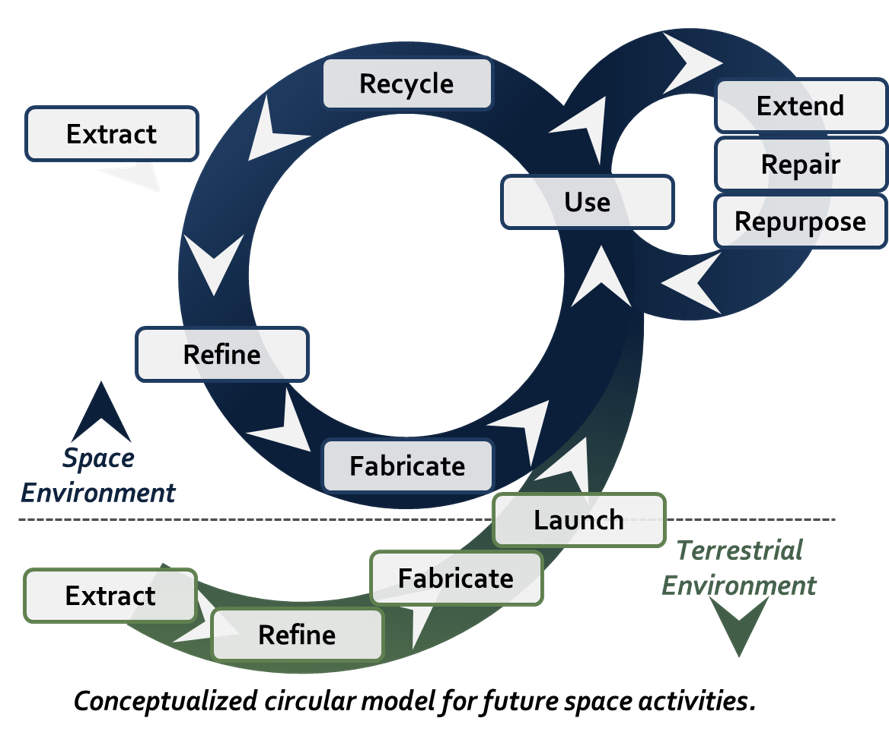
Conceptual circular model for in-space activities. Green denotes terrestrial activities, while blue denotes in-space activities. Terrestrial steps (extract, refine, fabricate, launch) feed an in-space loop that adds extend, repair, and repurpose pathways alongside use and recycling.
OSC and NIST gained a great deal of insight from circular space economy stakeholders over the duration of the seminar series and identified four areas of consideration for developing the in-space circular economy: policy and regulatory landscape, economic and financial models, physical and digital infrastructure, and materials science and manufacturing innovations. The report explores how progress across these areas could support a transition from single-use space assets toward infrastructure that serves multiple missions.
Policy and Regulatory Landscape:
The current space policy landscape is fragmented across multiple agencies for launch and reentry, spectrum, remote sensing data, and export controls independently. The seminars identified the absence of a clear mission-based authorization system as a policy barrier to the ISAM sector.
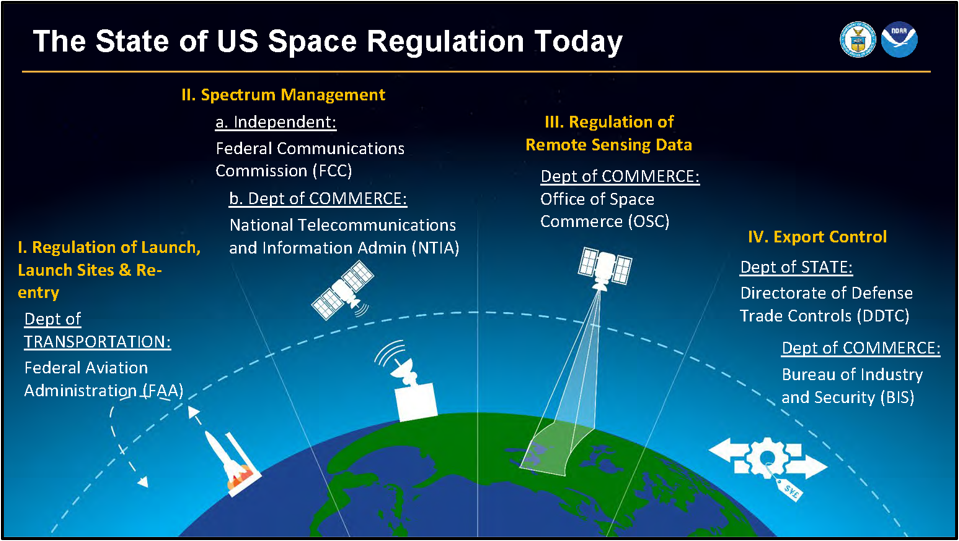
“The State of US Space Regulation Today,” showing Earth from space with satellites, a rocket launch, a ground antenna, a remote sensing satellite, and an export-control icon. The figure summarizes four major areas of U.S. space regulation and the responsible agencies. Image Credit: U.S. Office of Space Commerce.
Notably, on August 20, 2026, OSC officially announced a “Call for Interest” launching the pilot phase of its new Space Commerce Certification (SCC) Framework. It establishes a streamlined, voluntary, whole-of-government mission authorization framework to fast-track approvals for novel, commercial in-space activities such as ISAM, lunar manufacturing, and commercial space stations that fall outside traditional agency licensing. These novel activities are all in support of the circular space economy, as captured in the seminar series, and it is expected the SCC will lower the policy barriers identified in the seminar series.
Addressing this fragmentation also requires a well-supported government procurement system to initially stimulate the in-space circular economy, particularly for high capital expenditure investments. Strategic procurement can catalyze private sector development while establishing clear regulatory pathways.
Economic and Financial Models:
Transitioning to circular space operations requires evolving financial models to lower high upfront capital expenditure and long-term risk. To unlock private capital, the space ecosystem must transition toward project finance structures backed by government contracts, updated insurance products, and clear market incentives.
Microgravity manufacturing of semiconductors and biopharmaceuticals was highlighted as promising near-term, high-value opportunity. These initial ventures have the potential to generate the funds needed to support the long-term expansion of orbital recycling, servicing infrastructure, and the in-space circular economy broadly.
Physical and Digital Infrastructure:
Circular space operations require an integrated network of physical assets, such as serving hubs, modular platforms, and debris-capture systems, supported by secure digital and cybersecurity frameworks.
Processing orbital debris into feedstock requires supporting logistics for identification, capture, transport and storage. Additionally, the upcoming transition from the ISS to commercial low-earth-orbit destinations offers a critical window to maintain power, robotics, and operational continuity for orbital servicing networks.
Materials Science and Manufacturing Innovations:
Reusing materials and manufactured assets, as opposed to the costly single-use model, was emphasized by seminar participants. Toward this end, the recycling of parts must not be an afterthought of design, but a core component of it.
Gathering and processing materials available in space and on extraterrestrial surfaces is crucial to reduce assembly timelines and save costs. Thus, industry should aim to embrace the principles of “live off the land” and “repair not replace.”
Conclusion:
As the scale of the space economy continues to grow at exponential rates, it is critical to scale in a sustainable manner. The Building an In-Space Circular Economy seminar series successfully brought together key stakeholders from government, industry, and academia to address the technical, regulatory, and economic challenges facing the industry and to develop a circular space economy framework supporting ISAM.
A key outcome of the seminar series was the establishment of the Circular Space Economy Special Interest Group (SIG) under the Consortium for Execution of Rendezvous and Servicing Operations (CONFERS). The SIG will define principles that lay a foundation for an in-space circular economy. To join or learn more, visit the CONFERS Circular Space Economy SIG page.
Acknowledgements: On behalf of NIST and OSC, the authors thank the speakers, steering committee members, and leadership teams across the community whose expertise and contributions made the seminar series and report possible.
Access the Report:
A. D. Iams, K. Schumacher, J. J. Beam, C. M. Pace, D. L. Poster (2026) Building an In-Space Circular Economy – Seminar Series Report (National Institute of Standards and Technology, Gaithersburg, MD), NIST Special Publication (SP) NIST SP 1500-39. https://doi.org/10.6028/NIST.SP.1500-39
By: OSC Fall Fellows Alouetta Parsell, Cliff O’Rourke, & Chase Thompson