An official website of the United States government.


U.S. Space Industry Leaders Gather in Vienna, Launch $5 Million U.S. “Project Constellation” Space Initiative
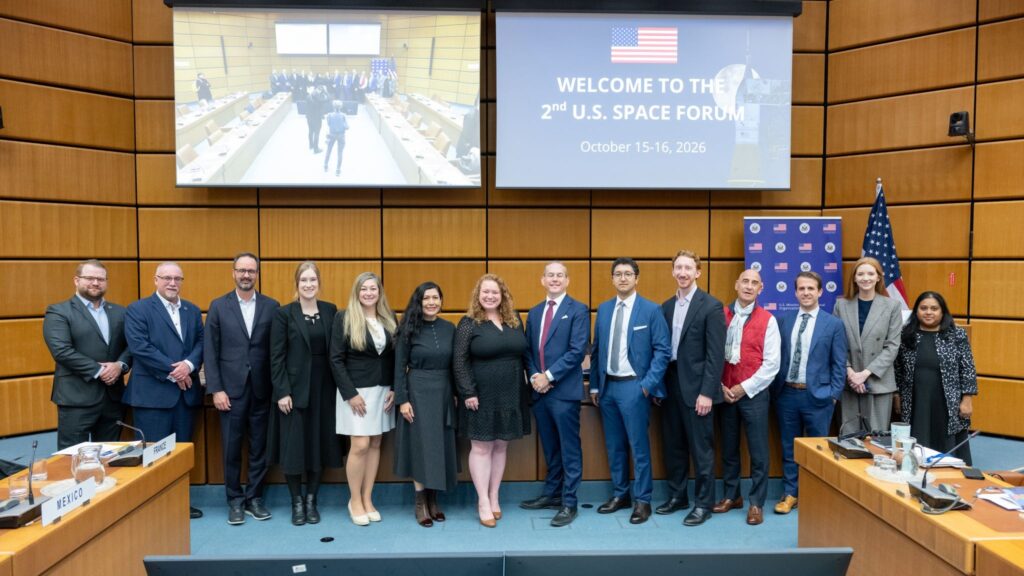
The U.S. Mission to International Organizations in Vienna is hosting the second annual U.S. Space Forum at the Vienna International Center, where the United States announced the launch of Project Constellation – a new $5 million initiative to foster partnerships with countries in space-related activities, advancing U.S. commercial and policy leadership in outer space.
Project Constellation will connect American companies, researchers, and space experts with international partners through commercial diplomacy, fellowships, pitch competitions, study tours, and cooperation on the safe exploration and use of space.
Read more on the U.S. Mission to International Organizations in Vienna website.
Read Ambassador Griffith’s Remarks.
U.S. Ambassador Griffith’s Remarks at The Second Annual U.S. Space Forum
Welcome to the second annual U.S. Space Forum in Vienna.
When we launched this gathering last year, it was born from a simple concept: that America’s long tradition of outer space leadership carries a responsibility to bring the global community together.
As you can see from our expanded program, this year’s forum has grown significantly. That expansion is intentional: it reflects our strong desire to broaden the conversation and deepen engagement with the rapidly growing community of global space actors. Humanity’s future amongst the stars is inevitable, and the journey there will be made possible only through the shared contributions of all of us.
Before we dive into our sessions, I want to take a moment to recognize and warmly welcome Kathleen Karika, NASA’s Associate Administrator for International and Interagency Relations, who is joining us today. Her leadership exemplifies the whole-of-government approach we have to advancing space innovation and cooperation globally.
I would also like to recognize the outstanding academics who have joined us this year to expand our knowledge and understanding of Outer Space Law.
The U.S. Space Forum is an opportunity for us to gather and discuss the developments, challenges, and opportunities in outer space. Free from the formal pressures of report writing, Conference Room Papers, or immediate deliverables. This is a collaborative forum for open dialogue and the exchange of ideas.
This year’s Forum is also an opportunity to announce “Project Constellation,” a new $5 million U.S. initiative focused on space cooperation and collaboration in the same spirit as the Space Forum. Project Constellation aims to launch a wide array of activities to support global space aspirations.
These include:
- a partnership pitch competition
- innovation showcases
- investor engagement
- study tours
- and gap-driven discussions focused on responsible space activities, regulatory alignment, space law and policy, workforce development, and entrepreneurship.
Each of these “Project Constellation” elements provide pathways to engagement with the U.S. space ecosystem.
That ecosystem includes private sector actors that are partnering with a growing number of nations and firms to spread the benefits of the outer space economy. Highlighting the possibilities of these partnerships and the importance the United States places on supporting our private sector and global partners, the State Department has launched the Space Catalyst Partnership, which leverages diplomatic outreach and industry engagement to accelerate commercial space competitiveness worldwide.
There is so much happening in space today, requiring deep consultation, coordination, and cooperation. Today, we have the opportunity to learn from our fellow COPUOS Member States, from academics at the top of their field, and – crucially – to leverage the incredible opportunities created by the private sector.
We will also hear from UNOOSA Director Holla-Maini for her vision on these pressing issues. Together, we must ensure COPUOS remains fit-for-purpose to address the evolving needs of space actors.
We need all of these voices and perspectives in the room. Today’s aspiring, emerging, and developing space nations will be tomorrow’s satellite constellation operators, and will contribute their citizens to the growing list of humanity’s cosmic ambassadors as astronauts.
The possibilities are as infinite as space.
During the course of the Space Forum, we are excited to share how U.S. space policies have allowed our commercial space sector to thrive and become a critical backbone of our national aspirations. We believe this framework offers a helpful template for other nations and private sector partners. As a result, we are witnessing the emergence of exciting plans for commercial space stations and space resource utilization, as well as expanding on-orbit satellite services, supported by companies from around the world.
A centerpiece of our discussions is the incredible momentum of lunar exploration, underscored by the historic success of the Artemis II mission and NASA’s bold new “Ignition” initiative — and the vision of establishing a permanent human presence on the lunar surface.
Artemis is a global endeavor, and we are thrilled to hear from our Artemis Accords partners during the Space Forum as well, and how the Accords shape their own approaches to outer space.
The Artemis Accords build upon the prescience of the Outer Space Treaty drafters to provide a roadmap for safe, peaceful, and sustainable space exploration. They affirm that space activities must be exclusively for peaceful purposes, enhance transparency, advocate interoperability, and promote scientific data sharing.
Furthermore, signatories commit to:
- Space debris mitigation as a core part of mission planning;
- Sustainable space resource extraction and utilization; and
- Preserving outer space heritage, such as Neil Armstrong’s boot print, India’s lunar south pole site and China’s far side landing site.
We are all here because we are inspired by the potential of space. I know that today’s discussions will harness that energy to guide our work within COPUOS and beyond in the coming years.
With that said, and with the exciting announcement about “Project Constellation,” I wish to thank you again for joining us this year, and may the conversations, connections, and learning be fruitful ahead.