 An official website of the United States government.


EUSST, TraCSS Publish Joint Study on Operational Information Exchange
Space debris and collision avoidance are challenges for all spacecraft, regardless of their nation of registry. As laid out in the Office of Space Commerce’s Vision for Global SSA Coordination, international collaboration is key to enhancing data consistency, coverage, and transparency.
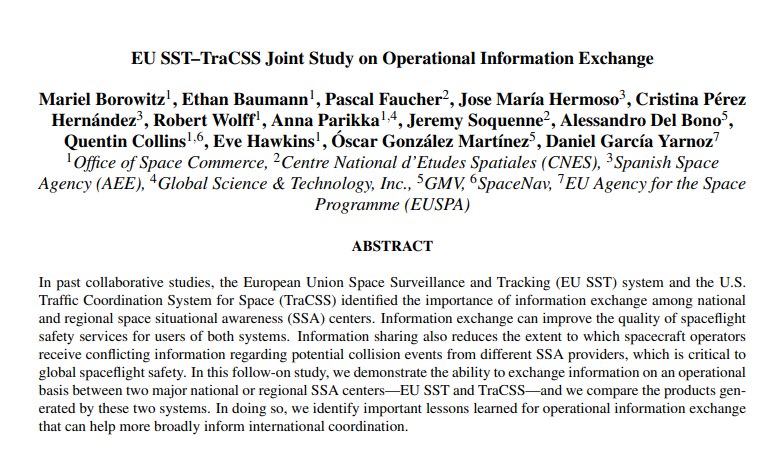
In past collaborative studies, the European Union Space Surveillance and Tracking (EU SST) system and the U.S. Traffic Coordination System for Space (TraCSS) identified the importance of information exchange among national and regional space situational awareness (SSA) centers. Information exchange can improve the quality of spaceflight safety services for users of both systems. Information sharing also reduces the extent to which spacecraft operators receive conflicting information regarding potential collision events from different SSA providers, which is critical to global spaceflight safety.
At the 2026 AMOS Conference, the TraCSS and EU SST published a joint study (copyright © 2026 Advanced Maui Optical and Space Surveillance Technologies Conference (AMOS) – www.amostech.com) that demonstrates the ability to exchange information on an operational basis between two major national or regional SSA centers—EU SST and TraCSS—and compares the products generated by these two systems.
In the analysis period, TraCSS published about 45 times as many conjunction events as EU SST. TraCSS published CDMs for 65% of the 1,432 events published by EU SST. An excess of events published exclusively by TraCSS is expected and explainable by differences in CDM publication rationale—approximately 70% of LEO events from TraCSS involve SPCAT ephemerides for Starlink secondaries, which EU SST will generally not publish when more preferable orbit data sources are available; and 95% of TraCSS-only events in GEO have a risk level below general thresholds for publication by EU SST. The presence of EU SST-only events appears to largely be a result of TraCSS only generating CDMs based on SPCAT data for certain objects. Further investigation is warranted to ensure that all relevant ephemerides are properly received and screened by each system.
These methodological differences do not necessarily suggest superiority of one system over the other. In general, EU SST prioritizes delivery of actionable data generated from high-priority sources. TraCSS takes a more comprehensive approach to screening and distribution of CA products, publishing a much greater quantity of CDMs of various types. Though not analyzed in this paper, both systems also screen and publish data for conjunctions between inactive or non-payload objects. EU SST screens large, non-maneuverable RSOs at least once per day using orbit data from the 18 SDS SPCAT without covariance and EU SST’s own sensor network. Resultant CDMs are available to all users registered to the EU SST portal. Two of TraCSS’ six daily comprehensive screenings additionally include the most up-to-date orbit data with covariance for all tracked debris and rocket bodies. TCNs for such high-risk events will be made publicly available by TraCSS.
Despite these differences, it became apparent through conducting the study that outputs from the two systems converge when they utilize similar inputs (i.e., operational data provided directly by O/Os). In light of the initial findings presented in this paper, a pragmatic approach based on information exchange for RSOs and orbital events between existing or developing SSA systems in different regions of the world would improve space safety and sustainability as part of a shared global responsibility. In this regard, it is important to improve transparency by ensuring timely access to O/O information. It is therefore essential to encourage O/Os to share their ephemerides (including maneuver plans) and satellite attributes like HBR with SSA systems to improve risk assessment and prevent catastrophic space collisions.